We harness the power of data for better decision making within an innovative organizational culture, through our team of Data Architects, Data Scientists and Data Engineers.
This evolves into gigantic volumes of data, which using the tools provided by the cloud allows us not only to improve its analysis but also to implement Machine Learning and AI to increase business intelligence.
Robotic Process Automation (RPA) and Artificial Intelligence that empower a rapid automation of end-to-end business processes and accelerate digital transformation.
Discovery workshop: The first step toward a true strategic digital partnership.
Before implementing new technologies, organizations need to understand where the greatest opportunities for value creation lie. A structured discovery process makes it possible to turn ideas into a concrete roadmap for innovation.
Technology trends 2026: The year of intelligent architecture
Technological evolution is no longer about adopting isolated solutions, but about designing intelligent architectures capable of learning, anticipating, and operating autonomously.
Financial Services in the Agentic Era: Modernize Without Losing Scale, Control, or Speed
95% of AI pilots fail to generate measurable financial impact. This paper explores how financial services organizations build real AI capabilities without sacrificing scale, control, or speed.
Learn about our architecture that combines at least one public and one private cloud to deliver the highest levels of scalability, flexibility, and performance.
Modernization of SAP on AWS: Efficiency, control and scale for a leading automotive company
A renowned automotive company accelerated its digital transformation by migrating and modernizing its SAP S/4HANA environment on AWS, ensuring operational efficiency, scalability and cost savings.
Gobernanza cloud que garantiza rendimiento, seguridad y eficiencia en el mundo del streaming
En un entorno donde la experiencia del usuario es clave, una reconocida plataforma de streaming confió en Nubiral para optimizar sus operaciones en AWS y escalar de forma segura, continua y eficiente.
Banking without core: APIs redefine competitive advantage
Agility and flexibility in the financial sector today arise from open architectures capable of linking services, integrating with ecosystems, and rapidly deploying new digital channels.
Application migration, optimization, efficiency, security, analytics and implementation services, with the aim of simplifying and accelerating the adoption of the latest IT trends in the market.
DevSecOps transformation: Speed, security and collaboration for modern development
A leading technology company modernized its development ecosystem with GitHub and Azure alongside Nubiral, reducing provisioning times and improving security.
Apps Modernization: Decisions That Redefine Business Agility
Evolving legacy systems without disrupting operations enables organizations to enhance development with AI, reduce technical debt, accelerate delivery cycles, and build software designed to continuously adapt to business demands.
We scale to environments with thousands of items monitored simultaneously.
We also capture data of systems and applications over time to make proactive decisions and to anticipate disruptions in business services.
End-to-End data governance for cybersecurity operations
One of the leading banks in Chile utilizes the most advanced AWS services to work on the ingestion, storage, detection, and predictive models of data from cybersecurity intelligence sources.
This new autonomous technology promises to accelerate business innovation, but it also raises questions about control, governance, and risk management in increasingly complex environments.
Secure AI development: Higher value and lower business risk
All about this approach to developing and deploying AI while ensuring ethical, legal, data protection, information security and accountability principles.
Discovery workshop: The first step toward a true strategic digital partnership.
Before implementing new technologies, organizations need to understand where the greatest opportunities for value creation lie. A structured discovery process makes it possible to turn ideas into a concrete roadmap for innovation.
This new autonomous technology promises to accelerate business innovation, but it also raises questions about control, governance, and risk management in increasingly complex environments.
Banking without core: APIs redefine competitive advantage
Agility and flexibility in the financial sector today arise from open architectures capable of linking services, integrating with ecosystems, and rapidly deploying new digital channels.
Financial Services in the Agentic Era: Modernize Without Losing Scale, Control, or Speed
95% of AI pilots fail to generate measurable financial impact. This paper explores how financial services organizations build real AI capabilities without sacrificing scale, control, or speed.
As an Advanced Consulting Partner of the AWS Partner Network, we think outside the box, daring to go where no one has gone before.
We constantly challenge ourselves to be better, providing your company with AWS solutions in a holistic and tailored way.
As Cloud Gold Partner, we work together with Microsoft every day to offer our clients the most innovative solutions based on the different microservices and capabilities that the Azure cloud offers.
Our team is constantly training and certifying on Azure’s services.
We scale to environments with thousands of items monitored simultaneously.
We also capture data of systems and applications over time to make proactive decisions and to anticipate disruptions in business services.
Nubiral and Diligent join to present a revolutionary solution that will transform the way organizations manage their GRC (Governance, Risk, and Compliance) processes.
We harness the power of data for better decision making within an innovative organizational culture, through our team of Data Architects, Data Scientists and Data Engineers.
This evolves into gigantic volumes of data, which using the tools provided by the cloud allows us not only to improve its analysis but also to implement Machine Learning and AI to increase business intelligence.
Robotic Process Automation (RPA) and Artificial Intelligence that empower a rapid automation of end-to-end business processes and accelerate digital transformation.
Discovery workshop: The first step toward a true strategic digital partnership.
Before implementing new technologies, organizations need to understand where the greatest opportunities for value creation lie. A structured discovery process makes it possible to turn ideas into a concrete roadmap for innovation.
Technology trends 2026: The year of intelligent architecture
Technological evolution is no longer about adopting isolated solutions, but about designing intelligent architectures capable of learning, anticipating, and operating autonomously.
Financial Services in the Agentic Era: Modernize Without Losing Scale, Control, or Speed
95% of AI pilots fail to generate measurable financial impact. This paper explores how financial services organizations build real AI capabilities without sacrificing scale, control, or speed.
Learn about our architecture that combines at least one public and one private cloud to deliver the highest levels of scalability, flexibility, and performance.
Modernization of SAP on AWS: Efficiency, control and scale for a leading automotive company
A renowned automotive company accelerated its digital transformation by migrating and modernizing its SAP S/4HANA environment on AWS, ensuring operational efficiency, scalability and cost savings.
Gobernanza cloud que garantiza rendimiento, seguridad y eficiencia en el mundo del streaming
En un entorno donde la experiencia del usuario es clave, una reconocida plataforma de streaming confió en Nubiral para optimizar sus operaciones en AWS y escalar de forma segura, continua y eficiente.
Banking without core: APIs redefine competitive advantage
Agility and flexibility in the financial sector today arise from open architectures capable of linking services, integrating with ecosystems, and rapidly deploying new digital channels.
Application migration, optimization, efficiency, security, analytics and implementation services, with the aim of simplifying and accelerating the adoption of the latest IT trends in the market.
DevSecOps transformation: Speed, security and collaboration for modern development
A leading technology company modernized its development ecosystem with GitHub and Azure alongside Nubiral, reducing provisioning times and improving security.
Apps Modernization: Decisions That Redefine Business Agility
Evolving legacy systems without disrupting operations enables organizations to enhance development with AI, reduce technical debt, accelerate delivery cycles, and build software designed to continuously adapt to business demands.
We scale to environments with thousands of items monitored simultaneously.
We also capture data of systems and applications over time to make proactive decisions and to anticipate disruptions in business services.
End-to-End data governance for cybersecurity operations
One of the leading banks in Chile utilizes the most advanced AWS services to work on the ingestion, storage, detection, and predictive models of data from cybersecurity intelligence sources.
This new autonomous technology promises to accelerate business innovation, but it also raises questions about control, governance, and risk management in increasingly complex environments.
Secure AI development: Higher value and lower business risk
All about this approach to developing and deploying AI while ensuring ethical, legal, data protection, information security and accountability principles.
As an Advanced Consulting Partner of the AWS Partner Network, we think outside the box, daring to go where no one has gone before.
We constantly challenge ourselves to be better, providing your company with AWS solutions in a holistic and tailored way.
As Cloud Gold Partner, we work together with Microsoft every day to offer our clients the most innovative solutions based on the different microservices and capabilities that the Azure cloud offers.
Our team is constantly training and certifying on Azure’s services.
We scale to environments with thousands of items monitored simultaneously.
We also capture data of systems and applications over time to make proactive decisions and to anticipate disruptions in business services.
Nubiral and Diligent join to present a revolutionary solution that will transform the way organizations manage their GRC (Governance, Risk, and Compliance) processes.
Discovery workshop: The first step toward a true strategic digital partnership.
Before implementing new technologies, organizations need to understand where the greatest opportunities for value creation lie. A structured discovery process makes it possible to turn ideas into a concrete roadmap for innovation.
This new autonomous technology promises to accelerate business innovation, but it also raises questions about control, governance, and risk management in increasingly complex environments.
Banking without core: APIs redefine competitive advantage
Agility and flexibility in the financial sector today arise from open architectures capable of linking services, integrating with ecosystems, and rapidly deploying new digital channels.
Financial Services in the Agentic Era: Modernize Without Losing Scale, Control, or Speed
95% of AI pilots fail to generate measurable financial impact. This paper explores how financial services organizations build real AI capabilities without sacrificing scale, control, or speed.
Amazon Bedrock AgentCore: From Assistants to Autonomous Agents
Amazon Bedrock AgentCore enables deploying autonomous AI agents in enterprise environments: reasoning, integration with corporate systems, and control at scale.
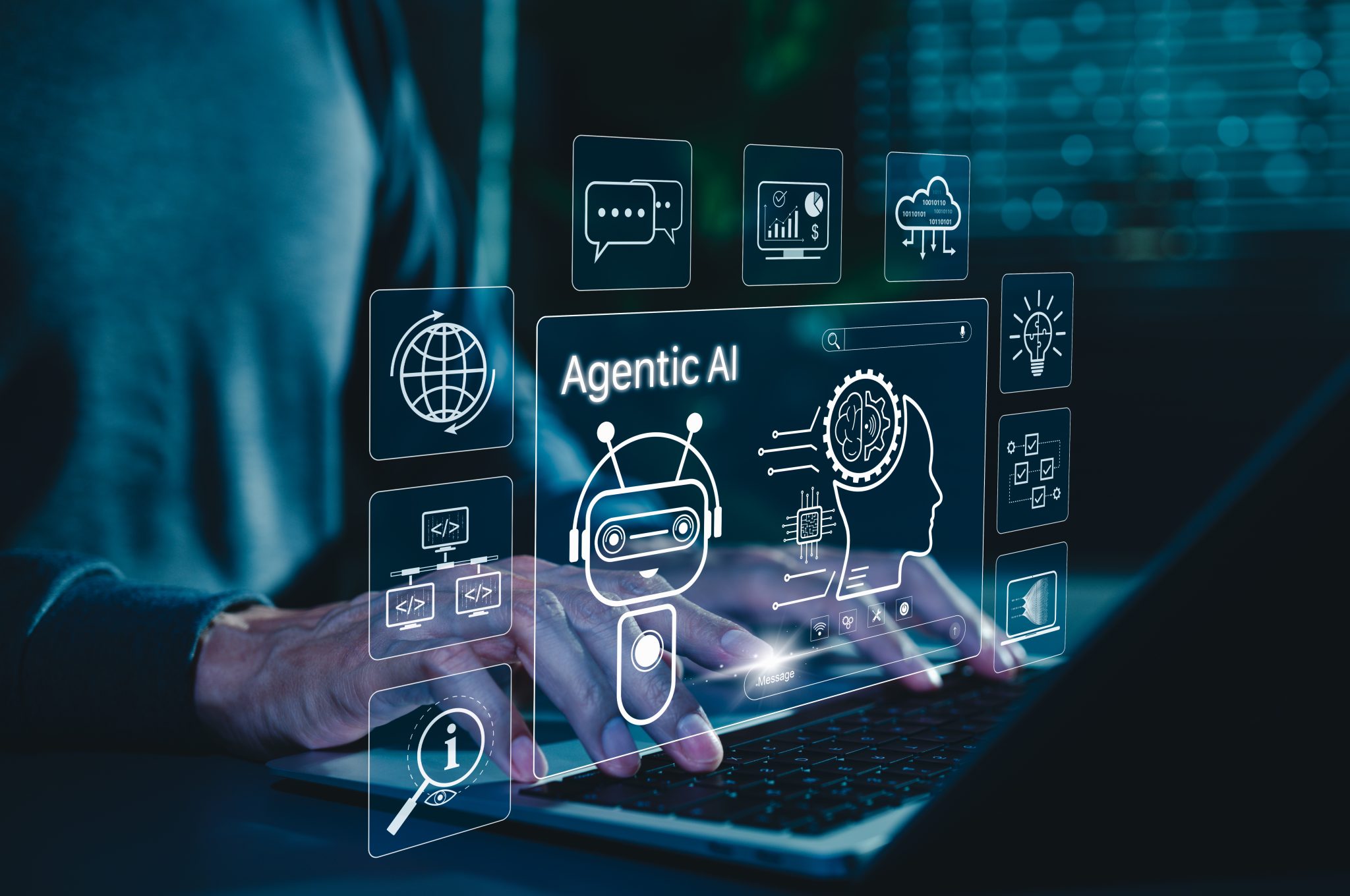
The shift toward the agentic AI paradigm is solid and accelerating. Unlike traditional assistants, intelligent agents are not limited to responding to requests. They are systems capable of reasoning, planning, and executing complex tasks autonomously. Additionally, they integrate directly into enterprise processes and applications. Platforms like Amazon Bedrock also incorporate new capabilities to facilitate the creation of these types of solutions.
Early systems based on generative models functioned as support tools. They could suggest code, draft text, or analyze information, but they still depended on constant interaction with the user.
Agentic AI introduces a fundamental difference: the ability to act. An agent can receive a goal, analyze different paths to achieve it, make intermediate decisions, and execute actions within digital systems.
Agents can interact with APIs, databases, corporate platforms, or business systems, automating processes that previously required human intervention. This shift opens the door to new levels of efficiency while also raising challenges in terms of control, security, and governance.
AgentCore: Infrastructure to Scale Agents
Amazon Bedrock AgentCore is a managed platform that facilitates the deployment of reliable AI agents, enabling their creation, implementation, and operation at scale.
It helps bridge the gap between prototypes and production environments by providing secure, scalable infrastructure without the need to manage servers.
Among its key components are several capabilities. For example, AgentCore Gateway connects agents with external tools and APIs—such as collaboration platforms, management systems, or enterprise applications—securely. This allows agents to interact with the company’s digital ecosystem without compromising data security.
AgentCore Runtime, meanwhile, provides a serverless execution environment that automatically scales agents and runs each session in isolated environments. This enhances security and ensures that each user’s interactions are processed independently.
What’s New: Memory, Learning, and Control
Additionally, Amazon Bedrock AgentCore has introduced episodic memory, enabling agents to remember specific interactions as discrete experiences.
Traditional models process each query independently. This capability allows the agent to learn from past experiences (within a session or across sessions, without modifying the underlying model). In practice, it can remember successful actions or mistakes and adapt its behavior in similar situations.
The platform also incorporates identity management and observability mechanisms to monitor agent behavior in real time. This includes access control, security tracking, and performance analysis of interactions.
Another notable capability is the Code Interpreter, which allows agents to write and execute code to solve complex tasks—from data analysis to process automation.
This set of tools makes it possible to build more sophisticated agents, capable of operating in enterprise environments with greater autonomy, while still maintaining control mechanisms.
Nova Act and Interface Automation
Another important advancement in this ecosystem is Amazon Nova Act, a service designed to address one of the long-standing challenges in automation: interacting with complex user interfaces.
Many tasks still depend on manual actions within web applications—filling out forms, retrieving information from corporate systems, or managing bookings. Automating these tasks is often difficult due to interface variability.
Nova Act enables the creation of agents capable of directly interacting with dynamic web interfaces, executing actions within enterprise applications with reliability levels above 90%. To achieve this, it was trained in environments known as “reinforcement learning gyms.” These replicate real platforms such as CRMs, human resources systems, or ticketing tools. This allows the agent to learn how to navigate them without impacting real production systems.
The Era of Agentic AI
The advancement of these technologies marks the beginning of a new stage in automation. However, turning these capabilities into real business value requires more than just technology. It involves designing appropriate architectures, integrating agents with corporate systems, and establishing governance models that ensure security and control.
At Nubiral, we have our Generative AI Center of Excellence (CoE) and a strong partnership with AWS to ensure our clients achieve secure, scalable, and business-oriented implementations of agentic AI solutions.
The transition from digital assistants to autonomous agents represents one of the most significant shifts in the recent evolution of AI. Agents are a concrete change in how organizations automate processes and make decisions—not as a replacement for humans, but as an execution layer operating within existing systems.
Is your organization ready to make the leap from “assistants” to “autonomous agents”? Our experts are ready to connect — schedule your meeting today!
Discovery workshop: The first step toward a true strategic digital partnership.
Before implementing new technologies, organizations need to understand where the greatest opportunities for value creation lie. A structured discovery process makes it possible to turn ideas into a concrete roadmap for innovation.
Technology decisions that must be made in 2026: The fundamental questions
Cloud and AI decisions can no longer be postponed: how you modernize, scale, and optimize today will define your ability to innovate, compete, and grow sustainably in the coming years.
Discovery workshop: The first step toward a true strategic digital partnership.
Before implementing new technologies, organizations need to understand where the greatest opportunities for value creation lie. A structured discovery process makes it possible to turn ideas into a concrete roadmap for innovation.
Webinar | Sustainability and Innovation: The path to an efficient and sustainable operation
Specialists in Sustainability and Business discuss the environmental problems that affect our daily lives, in addition with the benefits that the preservation of natural resources bring to companies.
Financial Services in the Agentic Era: Modernize Without Losing Scale, Control, or Speed
95% of AI pilots fail to generate measurable financial impact. This paper explores how financial services organizations build real AI capabilities without sacrificing scale, control, or speed.